
Multi-Timeframe Analysis: A Simple Strategy for Trading Multiple Timeframes
2026-11-10
Written by the Obelion team.
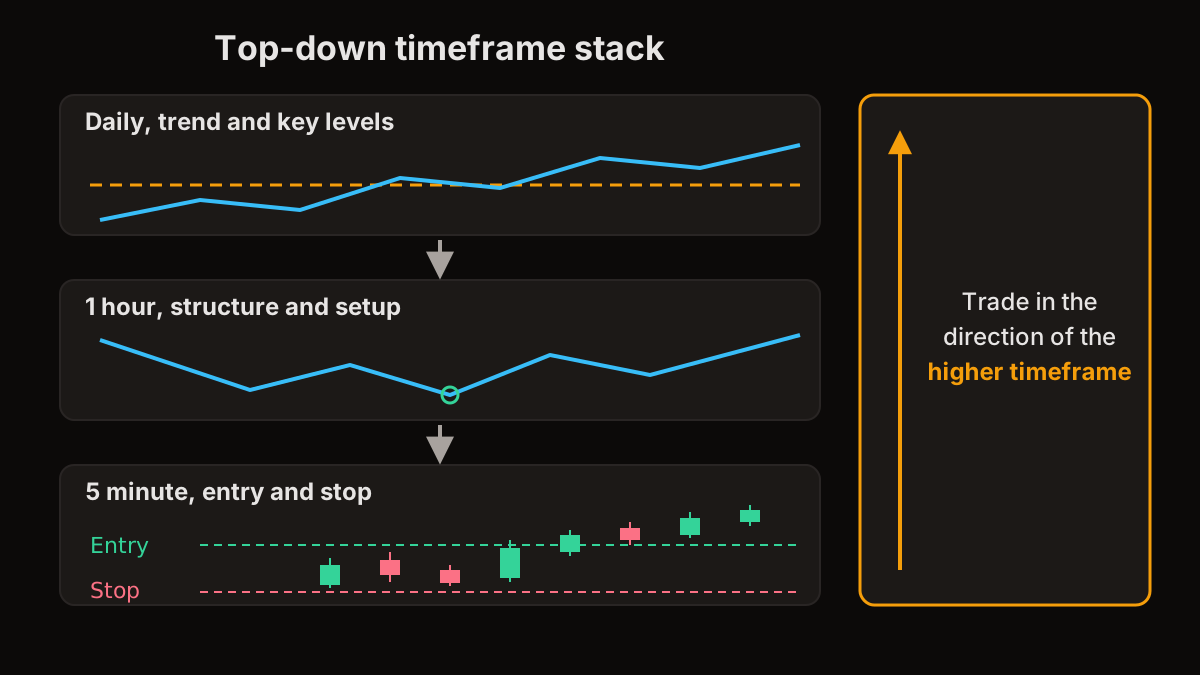
Multi-timeframe analysis means reading the same market on two or three timeframes before you trade it. The higher timeframe sets the trend and the key levels, the middle one shows the structure and the setup, and the lowest one times the entry and the stop. The basic rule is to trade in the direction of the higher timeframe.
How to pick your timeframes
A common rule is to space them by a factor of four to six. A day trader might use the daily, the 1 hour and the 5 minute. A swing trader might use the weekly, the daily and the 4 hour. Pick the lowest timeframe first, the one you'll enter on, and build up from there.
A multi-timeframe chart strategy, step by step
- Higher timeframe. Mark the trend and the two or three levels that matter most. Prior highs and lows, the point of control and big gamma levels are good candidates.
- Middle timeframe. Wait for price to reach one of those levels and look for structure: a higher low in an uptrend, a lower high in a downtrend.
- Lower timeframe. Enter on the break of that small structure, with your stop beyond the swing that would prove you wrong.
The trade you skip matters as much as the one you take. If the lower timeframe gives a long signal while the higher timeframe is in a clean downtrend, that's usually a pass.
Mistakes traders make with multiple timeframes
- Using too many timeframes, so one of them always disagrees and nothing gets traded.
- Switching timeframes mid-trade to find a reason to stay in a loser.
- Reading indicators with default settings on every timeframe, when the right settings often differ between a daily and a 5 minute chart.
Setting it up on Obelion
The chart supports layouts of two, four or six charts side by side depending on your plan, each on its own timeframe. Indicators, drawings and deep views work on every chart in the layout. Saved indicator stacks keep each indicator's settings, so you can keep a different setup per timeframe.
Questions about trading multiple timeframes
What is the best timeframe combination for day trading?
Daily, 1 hour and 5 minute is a common, workable set. Some traders swap the 1 hour for a 15 minute when they trade very short holds.
What if the timeframes disagree?
Trust the higher timeframe for direction. A disagreement usually means the setup isn't ready yet.
Can multi-timeframe analysis be used with options?
Yes. The higher timeframe helps you pick an expiration that gives the idea enough time, and the levels help you pick strikes.
The multi-timeframe analysis guide has a full worked setup. For the fundamentals behind trend and structure, see our market structure course.
Not financial advice. Disclaimer